
Equality
Duckmanton Primary School celebrates and supports diversity through our work with 'No Outsiders'.
Our school is a place where every child feels safe, respected, and celebrated.
We are proud to teach the values that prepare our pupils to thrive in a diverse and inclusive world.
Article 2 - All children have the right to be protected from discrimination, regardless of the language they speak, as well as other factors like race, gender, religion, disability, or wealth.
British Values
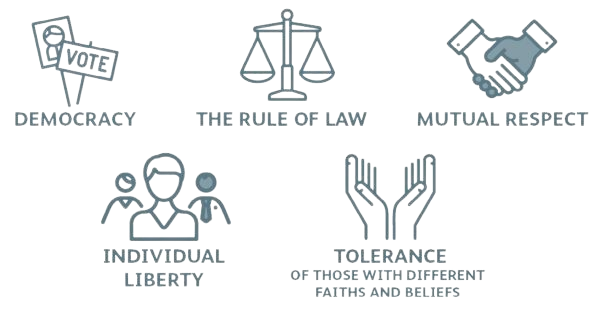
The DfE have recently reinforced the need to create and enforce a clear and rigorous expectation on all schools to promote the fundamental British values of democracy, the rule of law, individual liberty and mutual respect and tolerance of those with different faiths and beliefs.
We are committed to promoting the fundamental British values that help students become respectful, responsible, and active members of society. These values are embedded throughout our curriculum and school life:
Democracy
Duckmanton is a UNICEF Rights Respecting school. Each year, the children decide upon their class charter and the rights associated with these. All the children contribute to the drawing up of the charter.
Children have many opportunities for their voices to be heard. We have a school council which meets regularly to discuss issues raised in class council meetings. The council has its own budget and is able to genuinely effect change within the school. Two of the three council members for each year groups are voted in by their class. Each term, the children in years 2-6 are able to nominate and vote for children to achieve an “excellence certificate”.
Children have an annual questionnaire with which they are able to put forward their views about the school. Subject coordinators and Governors also survey the children annually. Teachers plan lessons responding to the children’s interests.
Article 12 – Respect for the views of the child
Children have the right to express their views in matters affecting them and have those views taken seriously.
The Rule of Law
The importance of laws, whether they be those that govern the class, the school, or the country, are consistently reinforced throughout regular school days, as well as when dealing with behaviour and through school assemblies. Pupils are taught the value and reasons behind laws, that they govern and protect us, the responsibilities that this involves and the consequences when laws are broken. Visits from authorities such as the Police and Fire Service help reinforce this message.
Article 3 – Best interests of the child
All actions concerning children must put the child’s best interests first (supports fairness and lawful treatment).
Individual Liberty
Within school, pupils are actively encouraged to make choices, knowing that they are in a safe and supportive environment. As a school, we educate and provide boundaries for young pupils to make choices safely, through provision of a safe environment and empowering education. Pupils are encouraged to know, understand and exercise their rights and personal freedoms and advised how to exercise these safely, for example, through our E-Safety and PSHE lessons. Whether it be through choice of learning challenge, of how they record, of participation in our numerous extracurricular clubs and opportunities, pupils are given the freedom to make choices.
Article 13 – Freedom of expression
Children have the right to seek, receive, and impart information and ideas of all kinds.
Mutual Respect
As a Rights Respecting School, mutual respect is at the heart of our values. Children learn that their behaviours have an effect on their own rights and those of others. All members of the school community treat each other with respect.
Tolerance of those of Different Faiths and Beliefs
Duckmanton is situated in an area which is not greatly culturally diverse, therefore we place a great emphasis on promoting diversity with children. Assemblies are regularly planned to address this issue either directly or through the inclusion of stories and celebrations from a variety of faiths and cultures. Our RE, PSHE and RRSA teaching reinforce this. Members of different faiths or religions are encouraged to share their knowledge to enhance learning within classes and school. Children visit places of worship that are important to different faiths.
Article 30 – Children from minority or indigenous groups
A child belonging to a minority has the right to enjoy their own culture, religion, and language.
At Duckmanton we will actively challenge pupils, staff or parents expressing opinions contrary to fundamental British Values, including ‘extremist’ views.
These British values are at the heart of our school culture. These values support our Gold Rights Respecting School status, helping us create a safe, inclusive environment where every child knows their rights, respects others, and is empowered to make a positive difference.
Protected Characteristics

At Duckmanton Primary school, we are committed to promoting equality, inclusion, and respect. The nine protected characteristics under the Equality Act 2010 are embedded across our curriculum, assemblies, PSHE (Personal, Social, Health and Economic) education, and daily school life. Here's how we explore and promote each one:
Article 2 – Non-discrimination
All rights apply to every child without discrimination, regardless of race, sex, religion, disability, sexual orientation, or any other status.
Age
We teach pupils to value people of all ages, promoting intergenerational respect. Through discussions, curriculum topics, and community links, we challenge age-related stereotypes and encourage empathy for both younger and older people.
Disability
Our teaching promotes understanding of visible and invisible disabilities. We focus on celebrating difference, removing stigma, and ensuring pupils understand the importance of accessibility, inclusion, and equality of opportunity.
Article 23 – Rights of children with disabilities
Children with disabilities have the right to live a full and decent life and receive special care and support.
Gender
At an age appropriate level, we help students understand that everyone has the right to express themselves and be treated equally, regardless of gender. We challenge stereotypes and promote respect for all genders across our curriculum and school life.
Marriage and Civil Partnership
We teach that families and relationships come in many forms, and that all loving, committed partnerships deserve respect. Pupils learn that marriage and civil partnerships are recognised equally under the law.
Pregnancy and Maternity
Pupils are taught to understand and respect the experiences of pregnancy, parenthood, and family life. We discuss the importance of support for parents and challenge stereotypes around parenting roles.
Race
We actively teach anti-racism and promote cultural diversity. Through history, RE, and PSHE, pupils explore different cultures and ethnicities and learn the value of equality, fairness, and standing up against racism.
Religion or Belief
Our curriculum includes the study of a wide range of religions and worldviews. We encourage respectful dialogue, tolerance, and curiosity, helping pupils to appreciate both shared values and unique traditions.
Article 14 – Freedom of thought, belief, and religion
Children have the right to think and believe what they want and to practice their religion.
Sex
We promote gender equality and teach that everyone, regardless of sex, should have the same opportunities and rights. Stereotypes are challenged, and pupils learn about equity in careers, leadership, sports, and relationships.
Sexual Orientation
We ensure that our teaching reflects and respects different sexual orientations. We promote inclusion and challenge homophobia through PSHE and literature.
No Outsiders Texts

To help our children understand more about diversity, we use the following texts:
Reception
- You Choose-Nick Sharratt and Pippa Goodheart
- Red Rockets and Rainbow Jelly- Sue Heap ad Nick Sharratt
- Hello Hello- Brendan Wenzel
- Blue Chameleon-Brendan Wenzel
- The Family Book- Toddd Parr
- Super Duper You- Sophie Henn
Year 1
- Elmer- David McKee
- I Love Me- Marvyn Harrison and diane Ewen
- Going to the Volcano- Andy Stanton
- Erol’s Garden- Gillian Hibbs
- The Boy Who Loved Everyone- Jane Porter and Maisie Paradise Shearring
- Bathe the Cat- Alice B McGinty and David Roberts
Year 2
- Can I Join Your Club? - John Kelly and Steph Laberis
- Splash- Clare Cashmore
- Amazing- Steve Antony
- How To Be a Lion- Ed Vere
- Is That Your Mamma?- Patrice Lawrence and Diane Ewan
- The Perfect Fit- Naomi Jones and James Jones
Year 3
- This Is Our House- Michael Rosen
- We’re All Wonders- RJ Palacio
- The Truth About Old People- Elina Ellis
- Nefertiti- Annemarie Anang and Natelle Quek
- Shu Lin’s Grandpa- Matt Goodfellow and YU Rong
- Aalfred and Aalbert- Morag Hood
Year 4
- Red Crayons Story- Michael Hill
- When Sadness Comes To Call- Eva Eland
- Julian is a Mermaid- Jessica Love
- My Beautiful Voice- Joseph Coelho and Allison Colpoys
- Milo Imagines the World- Matt de la Pena and Christian Robinson
- My Brother George- Kelly and Zoey Allen
Year 5
- The Girls- Lauren Ace and Jenny Lavlie
- The Boys- Lauren Ace and Jenny Lavlie
- And Tango Makes Three- Justin Richardson
- Mixed- Arree Chung
- My Shadow is Pink- Scott Stuart
- Remixed- Arree Chung
Year 6
- The Island- Armin Greder
- Introducing Teddy- Jessica Walton
- You’re So Amazing- James and Lucy Catchpole
- You Need To Chill- Juno Dawson
- The Proudest Blue- Ibtihaj Muhammed and S.K Ali
- Saving the Butterfly- Helen Cooper and Gill Smith
- A Day in the Life of Marlon Bundo- Marlon Bundo and Jill Twiss